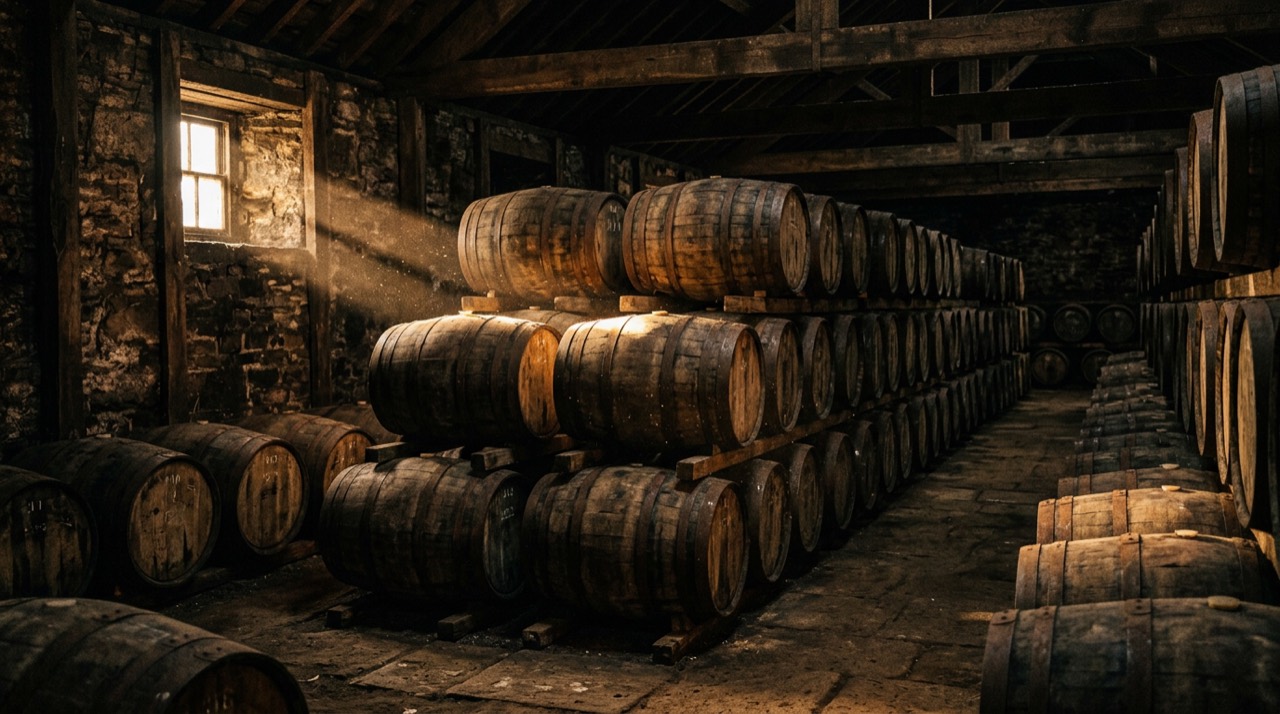
Over the past several years, I have spent a great deal of time speaking with distilleries, independent bottlers, cask owners, brokers and other people operating within the Scotch whisky trade.
One of the clearest trends I can see developing is a future shortage of genuinely desirable aged whisky stock.
When people hear the words “whisky shortage”, they often assume this means the industry is running out of whisky altogether. That is not what I am suggesting.
There may still be large quantities of younger spirit sitting in bonded warehouses throughout Scotland. However, having a large supply of young whisky is not the same as having an abundant supply of high-quality, mature stock.
A five-year-old cask cannot suddenly become an 18-year-old cask because demand increases. If a buyer needs mature whisky today, the spirit must already have been distilled and left to age for many years.
That is what makes the Scotch whisky supply cycle so unusual.
The decisions distilleries and farmers make today could affect the availability of aged whisky for the next ten, twenty or even thirty years.
The problem begins with barley
Barley is at the heart of malt whisky production, and the Scotch whisky industry depends heavily on Scottish agriculture.
However, not every barley crop is suitable for distilling.
Malting barley must meet strict requirements relating to moisture, nitrogen levels, germination and general quality. Even when farmers produce a successful harvest, a percentage of the crop may not meet the standards required by maltsters and distilleries.
This means the actual supply of usable distilling barley can be considerably smaller than the overall harvest figures suggest.
We are also seeing increasingly difficult growing conditions. Wet planting seasons, drought, extreme heat and unpredictable weather can all reduce yields or affect the quality of the final crop.
On top of this, farmers are facing greater environmental and agricultural restrictions.
Restrictions surrounding fertilisers, pesticides, crop-protection products, water usage and carbon emissions may be necessary as part of wider environmental policy. However, they also make the process of growing suitable malting barley more difficult and, in many cases, more expensive.
If the cost and risk of producing malting barley continue to increase, some farmers may decide to grow alternative crops that offer more reliable margins.
That would place further pressure on the quantity of suitable barley available to Scotch whisky producers.
Barley is only one part of the problem
The pressure on whisky production does not end with agriculture.
Distilleries also require significant amounts of water and energy. They need suitable oak casks, skilled staff, warehousing capacity, transport infrastructure and the financial ability to hold stock for many years before receiving a return.
The cost of producing a cask does not end when the spirit leaves the still.
The whisky then needs to be filled into oak, moved into bonded storage, monitored, insured and held throughout the maturation period. During that time, the producer receives no immediate revenue from the whisky sitting inside the cask.
When energy, finance, transport, labour and warehousing costs rise, distilleries must make difficult decisions about how much spirit they are willing to produce.
We have already seen a number of producers reduce output in response to softer short-term demand and higher operating costs.
From a business perspective, this is understandable. There is little benefit in producing at full capacity if companies believe they already have enough young spirit to meet their immediate requirements.
However, this creates a much bigger long-term issue.
Every year in which a distillery reduces production creates a smaller vintage.
That smaller vintage will eventually become the market’s 10-, 15-, 20- and 25-year-old whisky.
The industry cannot replace missing years
This is one of the most important things to understand about Scotch whisky.
The industry cannot immediately replace stock that was never produced.
A manufacturer of most goods can increase production when demand rises. A distillery can also increase production, but it cannot accelerate the ageing process.
If more 18-year-old whisky is required, the industry cannot simply produce it next month. The whisky must have been distilled at least 18 years earlier.
We have seen this cycle before.
Periods of weaker demand have historically led to reduced production, distillery closures and stock shortages. Years later, surviving casks from those periods became much harder to source.
In my view, today’s reductions in production will create similar supply gaps in the future.
The true effect may not become visible for many years. By the time the market recognises that a particular age or vintage is in short supply, it will already be too late to create more of it.
Aged whisky is constantly disappearing
Even when aged stock already exists, the available supply continues to decrease.
Each year, whisky is lost naturally through evaporation. This is known as the angel’s share.
Casks are also removed from the market when they are bottled, blended, recasked or purchased for private projects.
Once an aged cask has been bottled and consumed, that exact parcel of whisky is gone permanently. It cannot be replaced without beginning the maturation process again and waiting many years.
This means the supply of genuinely mature whisky is constantly reducing, even before we consider future production cuts.
The older a cask becomes, the more limited the potential supply becomes.
When you then narrow the requirement further by distillery, vintage, cask type, alcohol strength, remaining volume and quality, the number of suitable casks can become extremely small.
Global demand does not need to rise dramatically
Scotch whisky is already a global product, but there are still significant markets where its long-term potential is only beginning to develop.
India is now the largest export market for Scotch whisky by volume, yet Scotch still represents a relatively small percentage of India’s overall whisky consumption.
Improved trade arrangements and lower import tariffs could make Scotch more accessible to a much larger number of consumers over time.
China and other parts of Asia also remain important developing markets, particularly for premium and aged whisky.
The key point is that global demand does not need to double overnight to place pressure on mature stock.
The supply of genuinely aged whisky is already limited. Even a relatively small increase in demand from major international markets could create considerably more competition for the right casks.
Why I believe this is positive for existing aged stock
This is where I believe the market becomes particularly interesting.
The greatest potential benefit of reduced production may not be seen in newly filled casks. It may be seen in aged whisky that has already completed a substantial part of its maturation.
A cask that is already 10, 15 or 20 years old has something that cannot be manufactured or accelerated: time.
As younger production vintages become smaller, existing aged stock may become increasingly important to independent bottlers, blenders, brand owners, collectors and international buyers.
In practical terms, I believe this could lead to:
- Greater competition for suitable mature casks
- Increased demand from independent bottlers
- Stronger interest in stock from reduced-production vintages
- Larger pricing differences between young, widely available stock and genuinely scarce aged whisky
- More potential exit routes for owners of desirable mature casks
This does not mean that every old cask will automatically become valuable.
Age is only one factor.
The distillery, cask type, alcohol strength, remaining volume, purchase price, spirit quality and likely future buyer demand all need to be considered.
However, a well-selected aged cask has a fundamental advantage: the market cannot quickly produce another one.
My view of the market
I do not believe the Scotch whisky market is simply facing a universal shortage across every category.
The situation is more specific than that.
There may be a considerable amount of younger spirit available, particularly from years when distilleries increased production in anticipation of continued growth.
At the same time, genuinely desirable aged stock is becoming progressively harder to source.
Agricultural restrictions, difficult weather conditions, rising costs and reduced distillery output are limiting the quantity of spirit entering the maturation process.
Meanwhile, evaporation, bottling and global consumption continue to reduce the amount of mature whisky already in existence.
The effects of this will not necessarily be immediate.
In fact, the delayed nature of the supply issue is exactly what makes it so important.
The production decisions being made today may not be fully felt until the market looks for mature whisky in the 2030s and 2040s and discovers that considerably less was laid down.
For owners of carefully selected aged casks, I believe this widening gap between irreplaceable supply and future global demand could become one of the most important forces shaping the Scotch whisky market over the coming decades.
Whisky casks are a long-term, unregulated asset. Values can rise or fall, returns are not guaranteed, and liquidity can vary. Every cask should be assessed individually based on its purchase price, quality, provenance and potential future demand.